

process
unfinished women

1.
I wanted to be a doctor until pre-teen me had a panic attack witnessing a cousin’s wound paint a suburban Minneapolis sidewalk ruby. I wanted to be a lawyer, I wanted to be a luxury fashion buyer, I wanted to be a nun (long story), I wanted to own a museum, I wanted to be a neurosurgeon, I wanted to be a painter, I wanted to start an investment fund, I wanted to be an actress, I wanted to be a diplomat, I wanted to be a playwright, I wanted to be a cosmetologist, and these are the ones I remember.
As a child I was convinced that my mother could fly. What that did to a girl like me, wild and ruthless in bargains with my imagination, was to create a kind of charming delusional thinking which became my primary doctrine. I, yes I, could do and be anything. My mother could fly. I am my mother’s daughter. And therefore so could I.
I spent two weeks in Vienna, Austria after accepting a faculty position with a low-res MFA program. These programs have an annual requirement of up to three weeks of classroom time, then remote mentorship in their genre of choice during the school year. Most students finish these programs in three years or after completing a full-length manuscript. Vienna was my reintroduction to MFA programs. Vienna was also the longest time I had spent away from my children. It helps that my husband and I have the support we do, but it took several days to sleep through the night, to stop worrying about what they had eaten or if they had had productive days at school, dreading fresh wounds or ailments in my absence. When I settled in and opened my eyes, tempered my heart, I found the city beautiful.
Not quite sure what I was expecting (other than the obvious), the highlights included, in no particular order: the kindness of everyday people, impeccable architecture, the color ivory, students who like each other, watching world cup games with staff, and finally, Klimt.
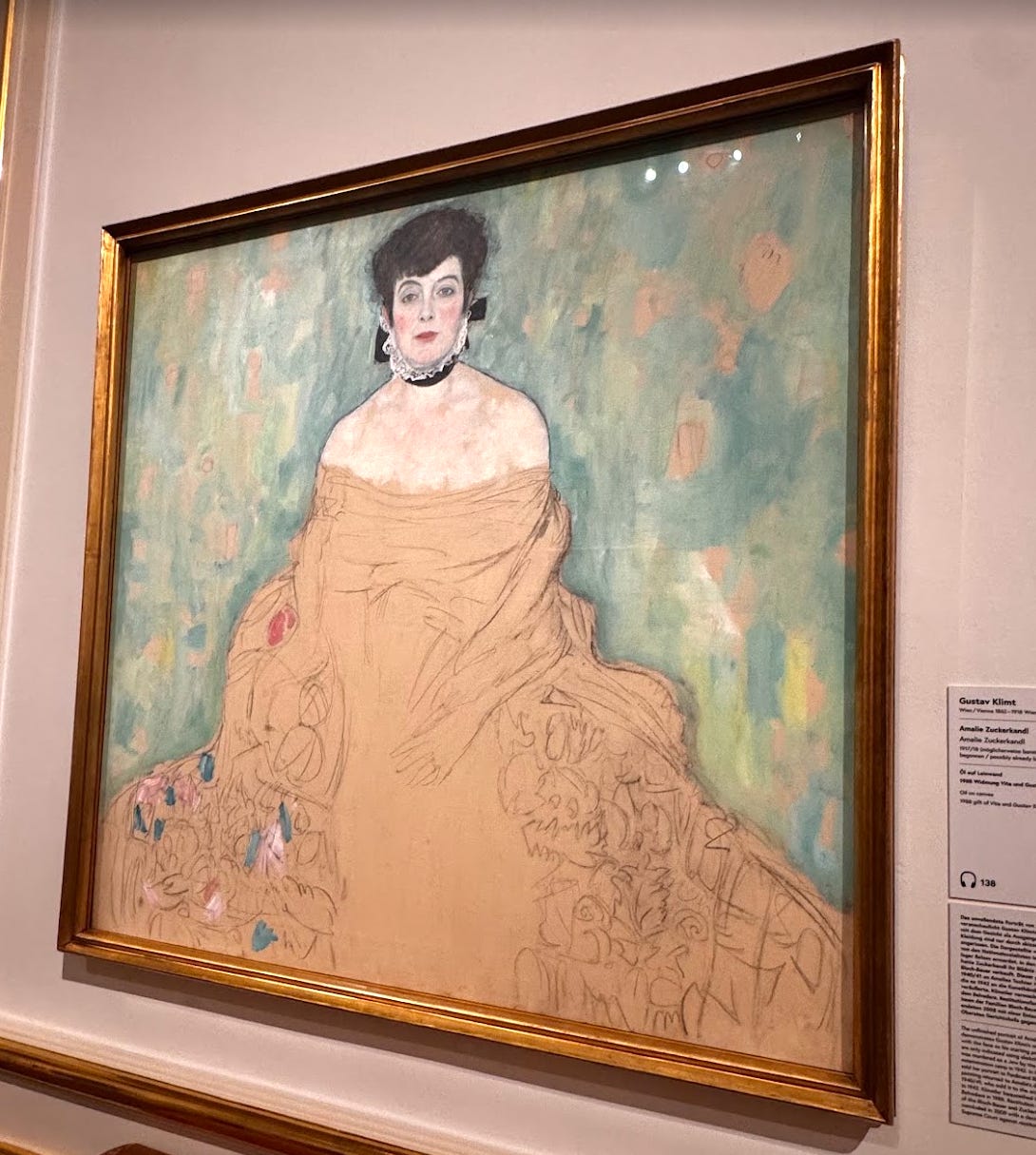
My hotel was close to The Belvedere Museum, where I spent a couple days strolling Gustav Klimt’s collection. The museum hosts Klimt’s permanent body of work, including his famous (and one of my favorite) painting/s, The Kiss. Her look of safety haunts me. So also, that day, did an unfinished portrait of a woman named Amalie Zuckerkandl. Klimt left a number of unfinished works at the time of his death, including this portrait, all revealing his creative process of pencil sketches eventually devoured by metallic leaves and paint. There was something spiritual about witnessing this exposure. Klimt and meandering pencil marks floating above lines that looked to have been erased. Some parts pedestrian, some parts ingenious. What is my process? I thought of it that day and I’ve started to consider a polished answer to the question since I will begin to formally speak about my sophomore novel this week. What graphite markings lay beneath?
3.
I convinced myself that the problem was logistics. How could I go to law school and cosmetology school at the same time? How would I network enough to get support for my fund as someone who enjoys being at home? What if diplomacy got in the way of my having children or vice versa?
So I became a writer. I took a job which requires I study all of the above: the quirks of the teacher and the twitch of the priest. I sit on the sidelines and I imagine all those lives I could have lived and I write them as calling, as gift.
4.
In addition to this standard definition: “a series of actions or steps taken in order to achieve a particular end” another explanation of the word process from my desktop dictionary is ‘a natural series of changes’. I estimate natural in this context to be relative. Aside from biological processes (and to an extent even this has variation), what is physiologically or emotionally natural for me may be different for you. It confuses me then, that we have all been radicalized to swallow standard life processes and roadmaps (usually geographically or culturally assigned) for success.
We go to school and school again. We assign markers of achievement that rarely stray from what the majority has determined. We wake up every morning at 5 AM to write. We meander for hours before finally getting to the work, which we finish in mid-to-late afternoon before eating, grocery shopping or playing with the children. I often wonder what our conversations would sound like, what our world would look like, if we allowed each other and ourselves the freedom to form our own processes to get to the finish line without labeling it deviant or divergent. I think we are too eager to assign virtue to prescriptive discipline. To wake at the same hour and draft in the same chair or special room or corner or cafe, to use the same sanctioned language to describe how we arrived at our stories.
The truth is I don’t wake up at 5 AM to write. My graphite marking is that I write whenever and wherever I can. I am composing this from an airplane right now. I write on napkins and my phone and occasionally while my children play in the background. I write at parks and in the middle of the night. I am hesitant to admit that because it is not the correct answer, is it? It lacks the version of disciplined routine assigned to serious writers. I write in the kitchen and on notepads and in the margins of books. My process is shaped by motherhood, by travel, by worry, by longing, by the remnants of every life I once imagined. The unfinished woman is the most honest piece of art I have seen in a while
.
Super-love this post. It could be a whole course.