


one
Writer Laura van den Berg’s Substack, Fight Week, had a gem recently, titled “On Pain.” It dissected how pain, in its many forms, shapes our lives and perceptions. One passage in particular stuck out to me while reading her introspections:
“Anyone who has ever worked on a novel for a long time has likely experienced the gutsick feeling of realizing the narrative architecture you’ve spent years honing is flawed at the root, or that character you’ve tried so hard to bring to life must be cut. And yet often these setbacks, which can feel so crushing in the moment, end up being the key that unlocks the door we must pass through in order to finish the book.”
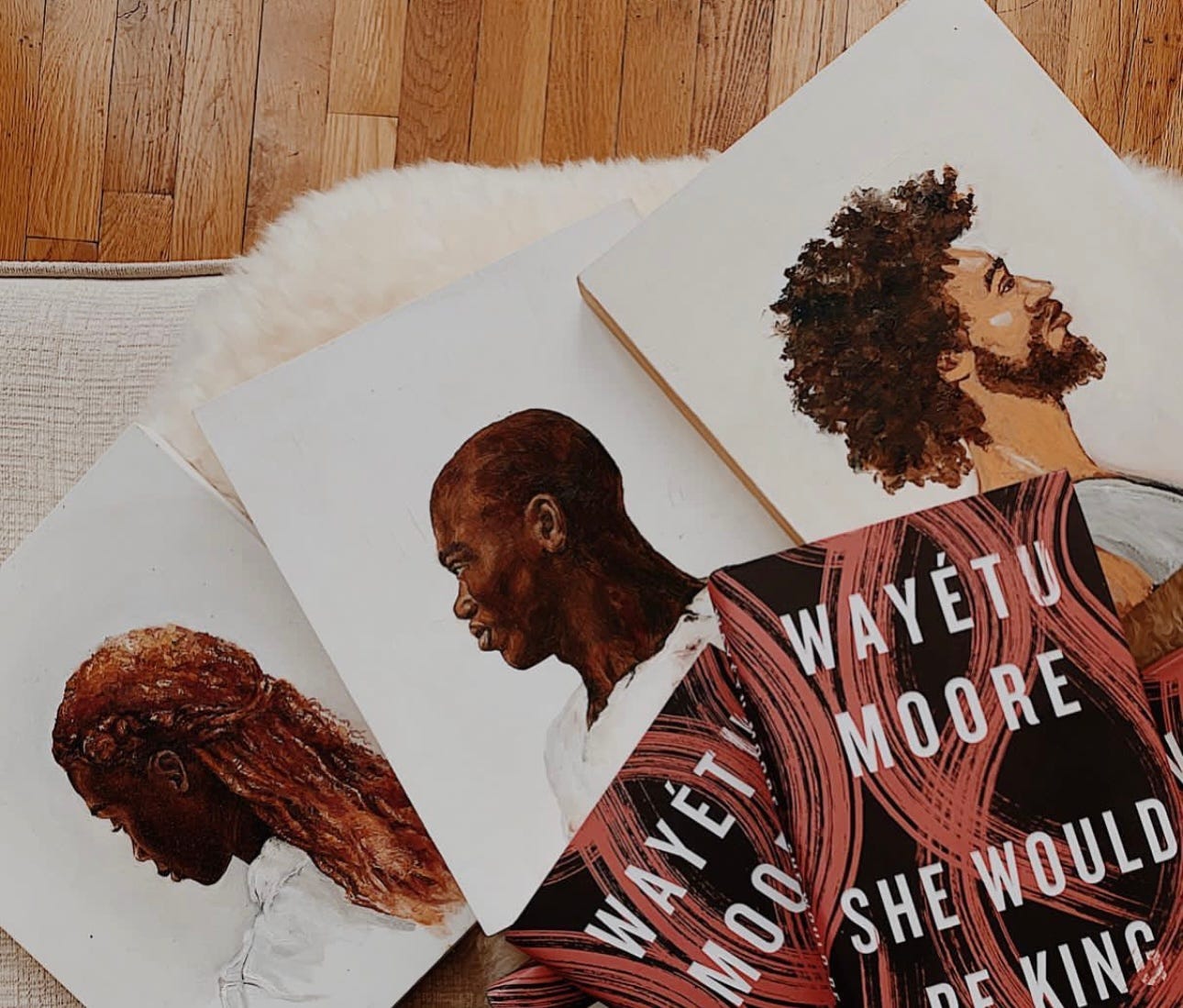
Her words resonated; I thought of my own journey with my first novel, She Would Be King. I finished the first draft in 2012, a too-long manuscript close to 550 pages. Over the next three years, I began the painful but necessary work of pruning. It was a process of distillation that took the book from 550 pages, to 437, and finally to the little over 300 pages that found their way into the world.
The most significant cut, however, was neither chapter nor subplot. I cut an entire character. He was called ‘the beggar,’ or Raggeb Eht. The beggar was an old man who attracted metal, an extraterrestrial repeatedly sent to earth to observe. He was conceived as a fourth protagonist, a strange yet (I perceived) necessary part to a whole. In my mind, he contributed to a story that examined not only where Liberia had been, but where it could go by offering symbolic glimpses into the country’s future. Yet, as the narrative found its true shape, his presence became the most obvious choice for excision. He was beautiful, but he did not belong. I remember the ache as I deleted the last of his dialogue. It felt like a burial.
Over the decade I spent with these characters, my understanding of the world, of womanhood, and of the story I needed to tell, evolved. As I changed, so did the novel. The cutting, the refining, was a part of that growth. Letting go of ‘the beggar’ was both a heartbreak and an act of service to the story. It allowed the three central protagonists, Gbessa, June Dey, and Norman Aragon, to step more fully into the light. The sacrifice was the key that unlocked its final form. For writers, for any artist, the page or the canvas can become a sacred space, and the idea of cutting can feel like a desecration. We pour our souls into characters, we build worlds and we become fiercely protective of every word. But the art of creation is also the art of letting go.
This is a universal truth for creators. This is a universal truth of humanity. Purging is prerequesite to clarity, to salvation.
two
We all have them. The people we have hoarded over the years. Righteousness demands that human beings are not disposable, so we rarely keep accounting of the individuals in our immediate orbit, even those relationships we have outgrown.
The indoctrination begins early. Phrases like “never give up on people” or “loyalty above all” are often extolled. Religion, too, can weigh heavily, with teachings that champion forgiveness and redemption over boundaries, nudging us toward patience rather than self-preservation.
My rearing taught me both. My parents fiercely censored who we spent time with and who we had in our home, while also teaching that people require patience and radical acceptance.
It took me years to realize that endings are not failures. They are necessary acts of authenticity. We spend years sometimes, in friendships and relationships wandering without purpose, a plotline for the sake of plotline. Or perhaps this habit begs the question, “how many versions of ourselves are we clinging to by maintaining outgrown relationships?”
three
I finally left New York. Again. For a number of reasons, we left. New York is singular. There are beautiful cities and reformed cities and old cities and cities that sing, and there is New York. There are home cities and vacation cities and cities that haunt and cities we hope to forget, and there is New York. There are classic cities and country cities and cities built on sand and cities built on institutions, and then there is New York. How many times had I tried to shed its skin, to bathe in sage to free myself from the many ghosts of myself I collected during my time there?
I moved there when I was seventeen years old from a small town in Texas, leaving for 3 years to obtain my undergraduate and graduate degrees in DC and Los Angeles, but I returned. I left again after the birth of my first son, spending 10 months in Houston with my family, but I returned.
I found a new city and I hope she is just as kind. It always smells like someone is celebrating with a feast, or like ocean salt has married spices, or someone left the bathroom door open with no shame. Streets unfold here with little order, though the madness does seem to have understood rules. Lagos shouts. Lagos gossips. Lagos is like a dusty rock that I am vigorously rubbing. And the more I rub, the shinier it becomes. Not a rock but a jewel. Sparkling when I move it. hypnotizing me to stay
four